Showing posts with label Humility. Show all posts

Tuesday, May 5, 2015

Inciting God’s Wrath


6 MAY


Therefore thus saith the Lord GOD; As the vine tree among the trees of the forest, which I have given to the fire for fuel, so will I give the inhabitants of Jerusalem. Ezekiel 15:6


SUGGESTED FURTHER READING: Matthew 3:7-12


As often as we are favored with God’s gifts, by which we approach Him and overcome the world, we ought also to remember what we were before God took us up. Acknowledging our original condition will erode all arrogance and prevent us from being ungrateful to God.

But that is not sufficient; we must also recognize that not only has God’s free grace raised us to such a height, but it also sustains us. Thus our continued state of grace is not because of our efforts but depends only on His will. Remembering our origin ought to humble us but also impress on us the sense of our infirmity. From this we learn that we cannot persevere unless God daily, yes, even momentarily, strengthens us and follows us  with His favor.

Finally, if God afflicts or chastises us with His rod, we should know that He chooses this means to beat out of us the foolish confidence by which we deceive ourselves. We thus ought to diligently weigh the meaning of the phrase “the wood of the vine is useless when it is torn up,” especially when dry. For although profane nations perish, yet it is not surprising that God’s judgments will be even more severe toward the reprobate who are members of the church and have been enriched with spiritual gifts, yet who persist in unbelief.

The punishment of such ingratitude will make us an example to others, so that whole world may be astonished at such dreadful signs of God’s anger. The Jews will become such objects of God’s wrath that they will cause hissing and abhorrence in the nations around them. They will be an astonishment and curse to the profane nations.


John Calvin


FOR MEDITATION:

The judgments that God will exact on those who belong to His church but are not true members are a terrifying prospect! The discipline that He uses to humble our pride is to be welcomed. It may be painful, but it reminds us that we owe everything to God’s grace.


365 Days With Calvin

Selected and Edited by Joel R. Beeke


Monday, May 4, 2015

Boasting in the Lord


5 MAY

Therefore thus saith the Lord GOD; As the vine tree among the trees of the forest, which I have given to the fire for fuel, so will I give the inhabitants of Jerusalem. Ezekiel 15:6

SUGGESTED FURTHER READING: 1 Corinthians 1:26-31


That this discourse might profit us today, we must perceive that we are superior to the whole world through God’s gratuitous pity, even though by nature we having to boast of in ourselves. We cannot carry ourselves with pride in our reliance on God’s gifts, for this would be sacrilege. We would in arrogance be snatching away from God His own praise and clothing ourselves, as it were, in His spoils.
Paul, in speaking of the Jews, shortly but clearly defines both sides of or condition: “Do we excel?” he asks (thereby making himself one with the Jews). “Are we better than the Gentiles?” (Rom. 3:1). He answers, “By no means, for Scripture denounces all of us as sinners who are cursed. Since we are all children of wrath, we can claim no superiority over the profane Gentiles.”
After prostrating the pride of his own nation, the Jews, Paul asks again: “What? Are we not superior to others?” He then answers, “Yes, in every way, for the adoption, worship, law of God, and covenant confer such remarkable superiority on us that cannot be found anywhere else in the whole world.”
How can the Jews excel and be preferred to others, yet excel in nothing? The answer is that they have nothing in themselves to allow them to despise the Gentiles of boast of themselves as superior because their excellence is not in themselves but in God.

John Calvin

FOR MEDITATION: God chooses men and women who are not worthy of His favor and pours His grace and mercy on them, making them new creatures. They may be preferred above all other people, but they can boast only in the Lord. If you have been chosen by God, do not boast in yourself; boast in the Lord for what He has done for you.

365 Days With Calvin
Selected and Edited by Joel R. Beeke

Thursday, February 19, 2015

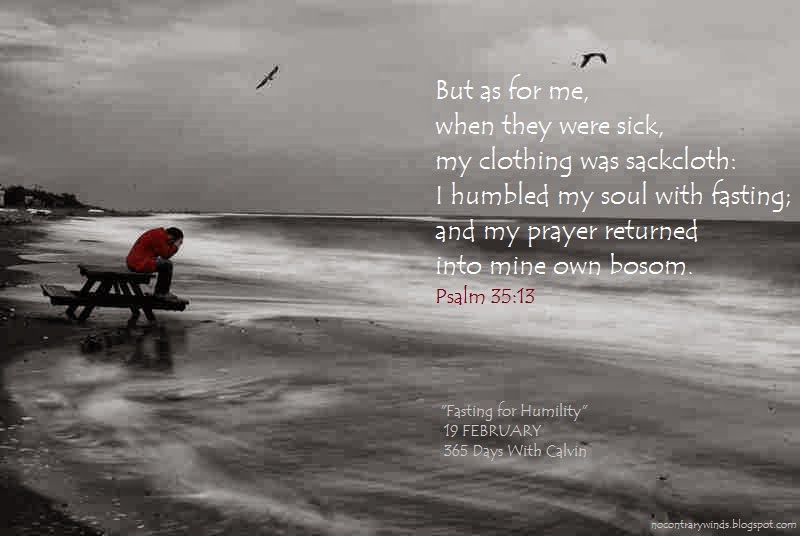
Fasting for Humility


19 FEBRUARY

But as for me, when they were sick, my clothing was sackcloth: I humbled my soul with fasting; and my prayer returned into mine own bosom. Psalm 35:13


SUGGESTED FURTHER READING: Matthew 6:16-18

The psalmist here presents putting on sackcloth and fasting as helps to prayer. The faithful pray even after their meals and do not regard daily fasting as necessary for prayer. Nor do they consider it necessary to put on sackcloth whenever they come into the presence of God. But those who lived in ancient times resorted to these exercises when an urgent necessity pressed upon them. In a time of public calamity or danger, believers put on sackcloth and fasted, believing that by so humbling themselves before God and acknowledging their guilt, they might appease His wrath. Likewise when someone was personally afflicted, he devoted himself to greater earnestness in prayer by putting on sackcloth and engaging in fasting as tokens of grief.
When David put sackcloth, it was to show that he had taken upon himself the sins of his enemies and begged for God’s mercy for them while they were exerting all their power to destroy him. Although we may regard the wearing of sackcloth and sitting in ashes as legal ceremonies, yet the exercise of fasting as people did in the time of David should remain in force today.
When God calls us to repentance by showing us signs of His displeasure, let us bear in mind that we ought not only to pray to Him in an ordinary manner but also to use such means that are fitting to promote our humility.

John Calvin

FOR MEDITATION: Though the outward observance of fasting has been a source of pride for some, it is intended to promote humility. We must use it likewise, neglecting neither fasting nor the humility it signifies.

365 Days With Calvin
Selected and Edited by Joel R. Beeke

Wednesday, February 11, 2015

Are You Humble?


If humility is the inseparable character of a godly man, let us test our hearts by this touchstone. Are we humble? Alas, where does their godliness appear who are swollen with pride and ready to burst? But though men are proud, they will not confess it. This bastard of pride is born but none are willing to father it. Therefore let me ask a few question and let conscience answer:


1. Are not those who are given to boasting proud? ‘Your glorying is not good’ ( 1 Cor. 5:6). 
(i) Those who glory in their riches; their hearts swell with their estates. St. Bernard calls pride the rich man’s cousin. ‘Thine heart is lifted up because of thy riches’ (Ezek. 28:5). (ii) Those who glory in their apparel. Many dress themselves in such fashions as to make the devil fall in love with them.Black spots, gaudy attire, naked breasts, what are these but the flags and banners which pride displays? 
(iii) Those who glory in their beauty. The body is but dust and blood kneaded together. Solomon says, ‘Beauty is vain’ (Prov. 31:30). Yet some are so vain as to be proud of vanity. 
(iv) Those who glory in their gifts. These trappings and ornaments do not set them off in God’s eyes. An angel is a knowledgeable creature, but take away humility from an angel, and he is a devil.


2. Are not those who have a high opinion of their own excellences proud? Those who look at themselves in the magnifying mirror of self-love appear in their own eyes better than they are. Simon Magus gave out that he was some great one (Acts 8:9). Alexander felt the need to be the son of Jupiter and of the race of the gods. Sapor, King of Persia, styles himself ‘Brother of the Sun and Moon’. ‘He tosses aside his paintpots and his words one-and-a-half feet long’ (Horace). I have read of a pope who trod upon the neck of Frederick the Emperor and as a cloak for his pride cited that text, ‘Thou shalt tread upon the lion, and the dragon shalt thou trample under feet’ (Ps. 91:13). There is no idol like self; the proud man bows down to this idol.


3. Are not those who despise others proud? ‘The Pharisees trusted in themselves that they were righteous, and despised others’ (Luke 18:9). The Chinese people say that Europe has one eye and they have two, and all the rest of the world is blind. A proud man looks upon others with such an eye of scorn as Goliath did upon David: ‘when the Philistine looked about, and saw David, he disdained him’ (1 Sam. 17:42). They who stand upon the pinnacle of pride look upon other men as no bigger than crows.


4. Are not those who trumpet their own praise proud? ‘Before these days rose up Theudas, boasting himself to be somebody’ (Acts 5:36). A proud man is the herald of his own good deeds; he blazes his own fame, and therein lies his vice, to paint his own virtue.


5. Are not those who take the glory due to God to themselves proud? ‘Is not this great Babylon, that I have built?’ (Dan. 4:30). So says the proud man, ‘Are not these the prayers I have made? Are not these the works of charity I have done?’ When Herod had made an oration and the people cried him up for a god (Acts 12:22), he was well content to have that honour done to him. Pride is the greatest sacrilege; it robs God of His glory.


6. Are not those who are never pleased with their condition proud? They speak harshly of God, taxing His care and wisdom, as if He had never dealt well with them. A proud man God himself cannot please but, like Momus he is for ever finding fault, and flying in the face of heaven.


Oh, let us search if there is none of this leaven of pride in us. Man is naturally a proud piece of flesh; this sin runs in the blood. Our first parents fell by their pride. They aspired to deity. There are the seeds of this in the best, but the godly do not allow themselves in it. They strive to kill this weed by mortification. But certainly where this sin reigns and prevails, it cannot stand with grace. You may as well call him who lacks discretion a prudent man, as him who lacks humility a godly man.


Thomas Watson

The Godly Man’s Picture, pp. 82-84


Tuesday, February 10, 2015

How may a Christian know that he is humble


Question: How may a Christian know that he is humble and consequently godly?


Answer 1: A humble soul is emptied of all swelling thoughts of himself. Bernard calls humility a self-annihilation. ‘Thou wilt save the humble’ (Job 22:29). In the Hebrew it is ‘him that is of low eyes’. A humble man has lower thoughts of himself than others can have of him. David, though a king, still looked upon himself as a worm: ‘I am a worm, and no man’ (Psa. 22:6). Bradford, a martyr, still subscribes himself a sinner. ‘If I be righteous, yet will I not lift up my head’ (Job 10:15) – like the violet which is a sweet flower, but hangs down the head.


Answer 2: A humble soul thinks better of others than of himself: ‘let each esteem other better than themselves’ (Phil. 2:3). A humble man values others at a higher rate than himself, and the reason is because he can see his own heart better than he can another’s . He sees his own corruption and thinks surely it is not so with others; their graces are not so weak as his; their corruptions are not so strong. ‘Surely’, he thinks, ;they have better hearts than I.’ A humble Christian studies his own infirmities and another’s excellences and that makes him put a higher value upon others than himself. ‘Surely I am more brutish than any man’ (Prov. 30:2). And Paul, though he was the chief of the apostles, still calls himself ‘less than the least of all saints’ (Eph. 3:8).


Answer 3: A humble soul has a low esteem of his duties. Pride is apt to breed in our holy things as the worm breeds in the sweetest fruit and froth comes from the most generous wine. A humble person bemoans not only his sins but also his duties. When he has prayed and wept, ‘Alas,’ he says, ‘how little I have done! God might damn me for all this.’ He says, like good Nehemiah, ‘Remember me, O my God, concerning this also, and spare me’ (Neh. 13:22). ‘Remember, Lord, how I have poured out my soul, but spare me and pardon me.’ He sees that his best duties weigh many grains too light; therefore he desires that Christ’s merits may be put into the scales. This humbles him to think that his best duties run to seed. He drops poison upon his sacrifice. ‘Oh,’ he says, ‘I dare not say I have prayed or wept; those which I write down as duties, God might write down as sins.’


Answer 4: A humble man is always preferring bills of indictment against himself. He complains, not of his condition, but of his heart. ‘Oh, this evil heart of unbelief!’ ‘Lord,’ says Hooper, ‘I am hell, but thou art heaven.’ A hypocrite is for ever telling how good he is. A humble soul is for ever saying how bad he is. Paul, that highflown saint, was caught up into the third heaven, but how this bird of paradise bemoans his corruptions! ‘O wretched man that I am!...’ (Rom. 7:24). Holy Bradford subscribes himself, ‘the hardhearted sinner’. The more knowledge a humble Christian has, the more he complains of ignorance; the more faith, the more he bewails his unbelief.


Answer 5: A humble man will justify God in an afflicted condition: ‘Howbeit thou art just in all that is brought upon us’ (Neh. 9:33). If men oppress and calumniate, the humble soul acknowledges God’s righteousness in the midst of severity: ‘Lo, I have sinned’ (2 Sam. 24:17). ‘Lord, my pride, my barrenness, my sermon surfeiting have been the procuring cause of all these judgments.’ When clouds are round about God, yet ‘righteousness is the habitation of His throne’ (Psa. 97:2).


Answer 6: A humble soul is a Christ-magnifier (Phil. 1:20). He gives the glory of all his action to Christ and free grace. King Canute took the crown off his own head and set it upon a crucifix. So a humble saint takes the crown of honour from his own head and sets it upon Christ’s. And the reason is the love that he bears to Christ. Love can part with anything to the object loved. Isaac loved Rebekah and he gave away his jewels to her (Gen. 24:53). The humble saint loves Christ entirely, therefore can part with anything to him. He gives away to Christ the honour and praise of all he does. Let Christ wear those jewels.


Answer 7: A humble soul is willing to take a reproof for sin. A wicked man is too high to stoop to a reproof. The prophet Micaiah used to tell King Ahab of his sin, and the king said, ‘I hate him’ (1 Kings 22:8). Reproof to a proud man is like pouring water on lime, which grows hotter. A gracious soul loves the one who reproves: ‘rebuke a wise man, and he will love thee’ (Prov. 9:8). The humble-spirited Christian can bear the reproach of an enemy and the reproof of a friend.


Answer 8: A humble man is willing to have his name and gifts eclipsed, so that God’s glory may be increased. He is content to be outshone by others in gifts and esteem, so that the crown of Christ may shine the brighter. This is the humble man’s motto: “Let me decrease; let Christ increase." It is his desire that Christ should be exalted, and if this is effected, whoever is the instrument, he rejoices. ‘Some preach Christ of envy’ (Phil. 1:15). They preached to take away some of Paul’s hearers. ‘Well,’ says he, ‘Christ is preached; and I herein do rejoice’ (v.18). A humble Christian is content to be laid aside if God has any other tools to work with which may bring Him more glory.


Answer 9: A humble saint likes that condition which God sees best for him. A proud man complains that he has no more; a humble man wonders that he has so much: ‘I am not worthy of the least of all thy mercies’ (Gen. 32:10). When the heart lies low, it can stoop to a low condition. A Christian looking at his sins wonders that it is no worse with him; he does not say his mercies are small, but his sins are great. He knows that the worst piece God carves him is better than he deserves; therefore he takes it thankfully upon his knees.


Answer 10: A humble Christian will stoop to the meanest person and the lowest office; he will visit the poorest member of Christ. Lazarus’ sores are more precious to him than Dives’ purple. He does not say, ‘Stand by, come not near to me, for I am holier than thou’ (Isa. 65:5), but ‘condescends to men of low estate’ (Rom. 12:16).


Thomas Watson

The Godly Man’s Picture, pp. 78-82